
Leadership on the Farm: Lessons for International Women’s Day
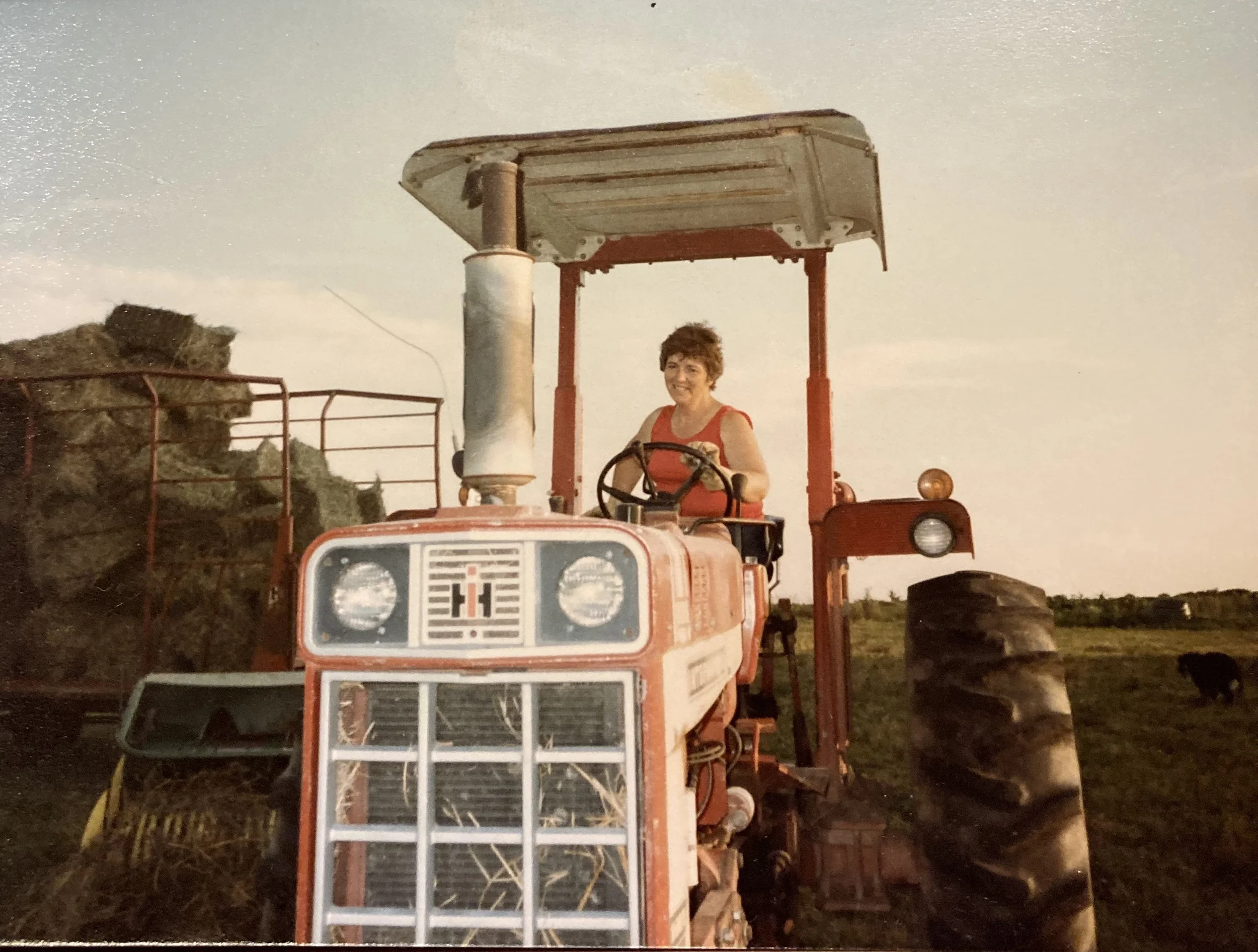
There's a photograph that keeps coming to mind as we enter the season of International Women’s Day.
My mom, sitting tall on a red International Harvester tractor, wearing a sleeveless top on a warm summer evening. Hay bales piled behind her. A wide-open field stretching to the horizon. And on her face—not strain, not performance—but a quiet, grounded smile.
She belongs there. She knows it. My dad knows it.
What you don’t see in the photo is the conversation that happened before it was taken: the patient afternoons my dad spent teaching her the machine—not because she had to learn, but because she wanted to. Not because there was a job opening. Not because someone approved her development plan. Simply because she was curious, and he said: “Let me show you.”
That was leadership. And I didn’t realize how rare it was until I left the farm.
Growing Up on a Farm
Farms teach lessons classrooms don’t:
You learn to read the weather before anyone tells you a storm is coming.
You learn that knowing how to operate a machine is more important than holding a title.
You learn that contribution matters. If you bale the hay, the hay gets baled, and animals get fed.
When I moved to the city and entered the professional workforce, I carried these lessons with me. But I quickly realized: the workplace runs differently. Subtle hierarchies, unspoken rules, and biases dictated readiness and value in ways I hadn’t encountered on the farm.
My mom was curious. My dad taught her. That simple model of curiosity, learning, trust, and contribution shaped her leadership—and it shaped mine, too.
What the Farm Got Right
Looking back, the farm modeled principles that workplaces are still discovering:
Capability is nurtured, not guarded. My dad didn’t require proof of skill before teaching my mom. He trusted her curiosity and capabilities.
Knowledge is shared, not hoarded. On a farm, information isn’t power—it’s survival. Withholding it undermines the collective effort.
Contribution has dignity. Every person’s work matters. Silos exist only for feed and grain.
Leadership is collective. It’s about getting the work done together, not about who stands at the front.
Rethinking Leadership
International Women’s Day celebrates women’s achievements—and it also invites us to rethink leadership.
The challenge isn’t that women don’t know how to lead. Women have been leading: in fields, in homes, in communities—sometimes quietly, sometimes visibly, and often without recognition.
For years, I struggled to see myself as a leader. My mental model of leadership was hierarchical, performative, and authoritative. It shadowed my internal knowing: leadership can be patient, curious, and grounded in shared capability.
What if leadership looked like my dad teaching my mom to drive a tractor?
Patient.
Trusting.
Curious.
Focused on building collective capability, not individual dominance.
What if organizations valued contribution at every level, not just at the top?
Somatic Awareness: Learning from the Body
Our bodies are constant instruments of information. Like a weather vane, they signal environmental cues.
In professional life, we’re often taught to leave our bodies at the door: suppress nerves, hide tension, and perform composure. But our bodies know what our minds wrestle with:
That knot in your stomach during a tense meeting? Information.
The relief when you finally feel seen? Information.
The exhaustion from translating yourself for others? Also information.
Somatic awareness—tuning into your body—isn’t soft. It’s smart. It’s a way to reclaim intelligence often overlooked in traditional leadership. Your nervous system is your oldest advisor.
The 3N Model™: Notice, Name, Navigate
Over time, I developed a framework to reconnect with embodied intelligence and lead with awareness: the 3N Model™.
🌿 NOTICE
Pause and observe: What is happening in your body right now? Tightness? Expansion? Shallow breath?
Prompts:
What am I feeling in my body in this moment?
Where do I feel this situation—chest, throat, gut?
🌿 NAME
Labeling emotions supports regulation and creates space for choice. Naming also breaks the isolation of unspoken experience.
Prompts:
If I had to put a word to what I’m experiencing, what would it be?
How do I know I’m feeling this way?
🌿 NAVIGATE
Respond, don’t react. Self-regulate in real-time.
Actions:
Feel your feet on the ground.
Breathe slowly, making your exhale longer than your inhale.
Ask: Is this unsafe—or just uncomfortable?
A Closing Thought
My mom didn’t need a leadership program. She needed someone to trust her enough to teach her the machine—and then get out of her way.
On International Women’s Day, I honor women like her: those who lead without a title, learn without permission, and carry families, farms, and communities with quiet competence.
And I challenge all of us:
Are we teaching people how the machine works and trusting them to drive?
Are we sharing knowledge as a resource, not guarding it?
Are we listening to what our bodies tell us about the cultures we create?
The 3N Model™ — Notice, Name, Navigate — is a tool for somatic awareness and regulated leadership. If you’d like to explore it for yourself or your team, please get in touch.
Happy International Women’s Day—to every woman who learns, leads by example, and keeps going.
